Strategic Five-Year Forecast: The Iloilo Business Park and the Rise of the Western Visayas Hub (2026–2031)

1. Macroeconomic Catalyst: The Decentralization Thesis and Regional Primacy
The Philippine real estate landscape is undergoing a structural transformation characterized by the decentralization of institutional capital away from the saturated Metro Manila market. Western Visayas has transitioned from a remittance-dependent region to a primary economic engine, demonstrating structural momentum that outperforms national averages. This shift is substantiated by a 6.4% regional GDP growth in 2025 and a 7.2% expansion in 2023, positioning Iloilo City as the premier secondary-market destination for capital allocators.
The primary validator of this decentralization thesis occurred in Q1 2026, when Iloilo officially overtook Metro Cebu in total occupied office space. For institutional investors, this milestone is a decisive “So What?”: it signals that corporate demand—traditionally concentrated in Cebu or Manila—has reached a critical mass in Iloilo. This corporate shift directly underpins residential and hospitality valuations, as the expansion of the professional class creates a permanent floor for rental yields and average daily rates (ADR). This macroeconomic outperformance is currently transitioning from a growth phase into a period of sustained yield compression, driven by high-velocity infrastructure integration.
2. Infrastructure as a Value Multiplier: Connecting the Visayan Archipelago
Large-scale infrastructure serves as a permanent upward reset for property valuations and regional trade efficiency. In the Western Visayas context, these mega-projects act as physical connectors that transform Iloilo into a regional logistics and tourism nexus.
Strategic Infrastructure Impact Matrix
| Project Name | Capital Investment | Timeline | Projected Impact on Iloilo Real Estate |
| Panay-Guimaras-Negros Bridge | ₱187.54B | 2026–2028 | Connects Panay to neighboring markets; stimulates trade/logistics and regional tourism. |
| Iloilo-Capiz-Aklan Expressway (ICAEx) | ₱126.00B | Active Phase | Reduces travel times island-wide; optimizes access for 5.8M annual tourists. |
The reduction in travel times across the archipelago creates a trade synergy that directly benefits the 72-hectare Iloilo Business Park (IBP). As inter-island connectivity improves, IBP matures into a regional hub for the 5.8 million annual tourists visiting the province, facilitating a rise in high-tier hospitality demand and commercial density.
3. The Iloilo Business Park (IBP) Ecosystem: Commercial and Office Dominance
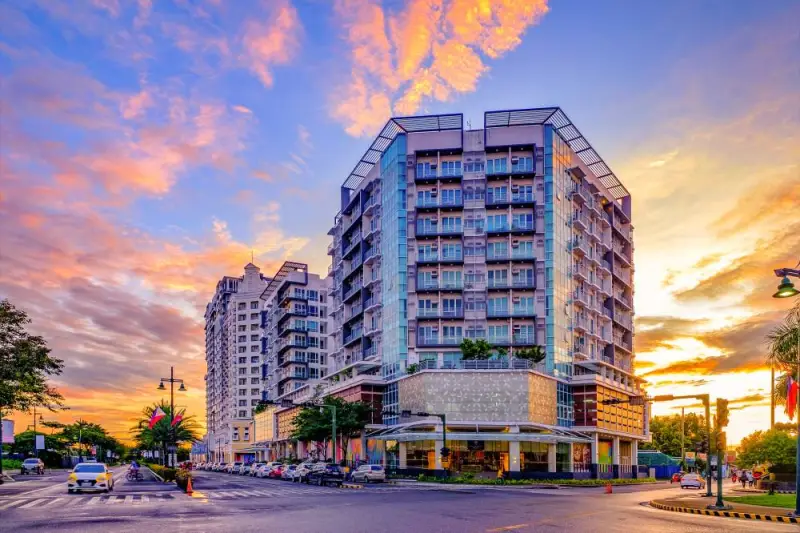
The “LIVE-WORK-PLAY” master plan of the Iloilo Business Park serves as a critical risk-mitigation strategy for institutional capital. Megaworld Corporation’s commitment is underscored by a projected ₱25 billion total investment into this 72-hectare development, creating a self-sustaining ecosystem resilient to localized market volatility.
Megaworld currently maintains a dominant 48% market share in the Iloilo office sector, managing 205,000 sqm of Gross Leasable Area (GLA) with a high-conviction 85% occupancy rate. The IT-BPM engine is the primary driver here; the sector grew from 15 companies in 2014 to 118 in 2024. While the region hosts 47,200 direct professionals, approximately 20,000 direct office jobs are located specifically within IBP. This concentrated professional base generates a non-seasonal demand for high-quality residential inventory and short-term lodging, effectively insulating the township from the wider market’s vacancy risks.
4. Hospitality Integration: The Rise of the MICE and Tourism Sector
The Meetings, Incentives, Conferences, and Exhibitions (MICE) sector is a strategic pillar for driving premium ADR and hotel occupancy. By clustering high-density hospitality assets near the Iloilo Convention Center, the township has created a “MICE Hub” capable of achieving 90%+ occupancy during major regional events.
The Belmont Hotel Iloilo, which opened on June 24, 2026, is the city’s largest hospitality asset with 405 rooms. Investors should note a significant supply-side nuance: Belmont represents approximately 25% of Iloilo City’s total hotel inventory. This concentration introduces a near-term “ramp-up” occupancy risk, though it is mitigated by a mandatory 15-year leaseback mechanism and a pooled-profit structure. This structure ensures that net dividends—audited by Punongbayan and Araullo (P&A)—are distributed based on total hotel performance rather than individual room occupancy.
Belmont Suite Asset Classes & Projections:
- Twin/Queen Suite (24 sqm): Entry-point for business travelers. Pricing: ~₱10.15M.
- Junior Suite (31 sqm): Premium business tier. Pricing: ~₱13.10M.
- Executive Suite (52 sqm): VIP/Convention speaker segment. Pricing: ~₱21.89M.
- Yield Benchmark: Advertised ROI ranges from 7.5% to 14% annually, supplemented by a “lifestyle yield” of 30 complimentary nights per year.
5. Residential Asset Trajectory: Conventional Condominium Performance
Conventional residential units offer a “high-control” alternative to the passive hospitality model. These assets provide investors with maximum flexibility in rental pricing, tenant selection, and exit timing.
Residential Inventory and Performance Matrix
| Project Name | Status | Entry Price (Approx.) | Typical Monthly Rent | Key Yield Drivers |
| The Pinnacle | Pre-selling | ₱4.52M | ₱25k – ₱45k | Newest inventory; high-spec finishes. |
| Saint Honore | RFO | ₱4.80M | ₱25k – ₱45k | Established demand; 10-story density. |
| Firenze Residences | Pre-selling | ₱7.25M | ₱35k – ₱60k | Italian-inspired; smart-home units. |
| The Palladium | RFO | ₱18.00M (2BR) | ₱50k – ₱80k+ | High-tier executive segment. |
On an unlevered basis, conventional assets in IBP deliver rental yields of 6% to 11% annually in high-performing units (e.g., Saint Honore or Firenze), with annual capital appreciation averaging 5% to 8%. However, unlike the “hands-free” Belmont model, these assets require active management of maintenance and tenant turnover.
6. Five-Year Investment Trajectory: Risks, Rewards, and Strategic Framework
The 2026–2031 outlook for Iloilo Business Park is one of resilience compared to Metro Manila. However, capital allocation must be aligned with specific liquidity and management profiles.
Investor Alignment Matrix
| Investor Profile | Recommended Asset | Strategic “Why” | Horizon |
| Passive / OFW | Belmont Condotel | 100% hands-free; audited by P&A; 30-night perk. | 10+ Years |
| Active / Entrepreneur | Conventional Condo | Control over pricing; 11% yield potential; resale flexibility. | 5–10 Years |
| Capital Preservation | Conventional Condo | Lower entry point (~₱3.5M); 3x lower barrier than Belmont. | 5+ Years |
Risk Mitigation and Due Diligence:
- The “Supply Shock”: Investors must factor in a stabilization period as Belmont’s 405 rooms are absorbed into the city’s 25% supply share.
- Tax Thresholds: Be advised that the VAT-exempt threshold is ₱3.6M. Many IBP units now exceed this, increasing the effective acquisition cost.
- Regulatory Nuance: Condotels are often classified as SEC-regulated investment contracts rather than simple real estate; ensure due diligence on the hotel participation agreement.
- Exit Liquidity: Conventional condos benefit from a broader resale pool (end-users + investors), whereas condotels have a narrower, specialized secondary market.
The “So What?” Final Word: The Iloilo opportunity is defined by the convergence of 9% rental growth, a ₱25B township commitment, and a regional economy that has successfully challenged Cebu’s dominance. Whether through the 7.5%–14% ROI potential of the Belmont hospitality model or the high-control, 11%-yield trajectory of residential towers like Firenze, Iloilo Business Park remains the highest-conviction play for regional decentralization through 2031.
Ready to talk about smarter investments?
Feel free to reach out or message me directly. I’m here to help

Contact
Mobile / SMS / VIBER / WHATSAPP: +63 928 503 5321
Email: consult@iloilocondominiums.com